
Have you ever noticed a pink tinge of blood when you…
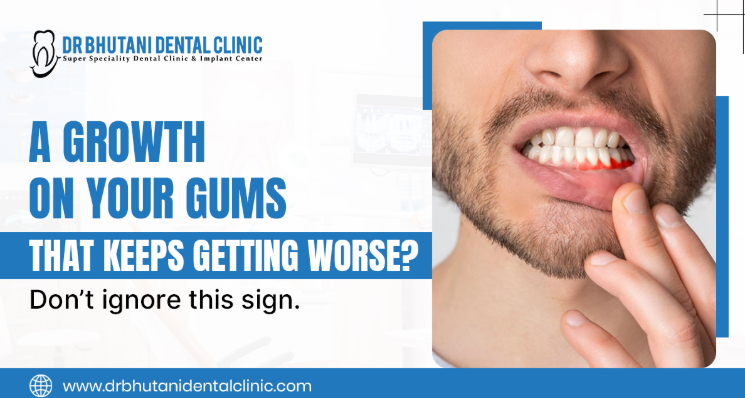
A Growth on Your Gum That Keeps Getting Worse?
That small bump on your gum that you’ve been ignoring? It may be trying to tell you something important.
You noticed it a few weeks ago — a small lump, a raised patch, or an unusual growth on your gum. Maybe it bled a little when you brushed. Maybe it didn’t hurt at all, so you left it alone, hoping it would go away on its own. But it didn’t. It stayed. And now it seems to be getting bigger.
A growth on your gums that keeps getting worse is never something to dismiss. It is your body sending an urgent signal that something beneath the surface needs attention. Ignoring it doesn’t make it go away — it gives it time to progress.
What exactly is gum Growth?
A gum growth — medically referred to as a gingival mass, gingival enlargement, or epulis — is any abnormal tissue that develops on the gum. It can appear as a small bump, a raised nodule, a soft fleshy lump, or even a flat, thickened patch. It may be the same colour as your gums, or it may appear red, white, purple, or darkened.
Not all gum growths are the same. Some are benign and easily treated. Others are signs of a deeper infection or, in rare cases, something more serious. What they all have in common is this: they do not disappear on their own, and they almost always worsen with time if left unaddressed.
Why Is It Getting Worse?
This is the most important question — and the one that should push you toward seeking professional care. A growth that is increasing in size, changing in colour, becoming painful, or starting to bleed more frequently is a growth that is actively progressing. Here is why that happens:
The underlying cause is still present. Gum growths rarely appear without reason. If the trigger — whether it’s infection, irritation, hormonal change, or medication — is still active, the growth will continue to develop.
Bacteria are at work. The mouth is full of bacteria. A growth that creates pockets or crevices near the gum line becomes a breeding ground for bacterial activity. Poor oral hygiene allows this to spiral, making the growth larger and more inflamed.
Inflammation feeds growth. Chronic inflammation in gum tissue stimulates abnormal cell activity. The longer inflammation persists, the more the tissue responds by growing. This is why gums bleeding alongside a growth is a serious warning sign — it indicates active inflammation that is not resolving.
You may be masking the pain. Many people take over-the-counter painkillers when a gum growth becomes uncomfortable. This does not treat the cause — it simply allows the underlying condition to worsen undetected.
What Are The Common Causes of Gum Growths?
Understanding what might be causing your gum growth is key to treating it correctly.
1. Chronic Gum Infection (Periodontitis)
One of the most common causes of abnormal gum tissue growth is untreated gum disease. When infection spreads beneath the gum line, the body responds with inflammation and tissue overgrowth. Gums bleeding, swelling, bad breath, and a visible mass near the gum line are all classic signs that infection has taken hold and is advancing.
2. Pyogenic Granuloma
This is a soft, bright red, rapidly growing lump on the gum that bleeds very easily — even with the lightest touch. It is most commonly triggered by minor trauma, chronic irritation, or hormonal changes. It is benign but grows quickly and almost always requires removal. It is frequently seen during pregnancy, earning it the nickname “pregnancy tumour,” though it can affect anyone.
3. Fibrous Epulis
A firm, flesh-coloured growth that develops in response to long-term irritation from rough fillings, ill-fitting dentures, or dental appliances. It is slow-growing, generally painless, and doesn’t bleed as readily — but it does not go away without treatment.
4. Peripheral Giant Cell Granuloma
A distinctive dark red or purple growth that appears between teeth or on the gum margin. It is more aggressive than a typical epulis and has a tendency to recur after removal if the underlying irritant is not addressed. Gums bleeding around this type of growth is very common.
5. Medication-Induced Gingival Enlargement
Certain medications — particularly anti-seizure drugs like phenytoin, calcium channel blockers used for blood pressure, and immunosuppressants — can cause the gum tissue to overgrow significantly. This type of growth can cover parts of the teeth and creates areas where plaque accumulates, worsening the condition further.
6. Oral Fibroma
A smooth, firm, painless lump that commonly develops in response to repeated irritation — from cheek biting, a rough tooth edge, or a poorly fitting appliance. While completely benign, it will not resolve without removal.
7. Abscess or Gum Cyst
A collection of pus from a bacterial infection can present as a raised, painful swelling on the gum. This is a dental emergency. An abscess will not drain or heal on its own — it will spread. Accompanying symptoms include throbbing pain, gums bleeding, fever, and a foul taste in the mouth.
8. In Rare Cases — Oral Cancer
While the majority of gum growths are benign, a persistent, non-healing growth that continues to enlarge — particularly one that is hard, ulcerated, bleeds spontaneously, or is accompanied by numbness — must be evaluated promptly for malignancy. Early detection of oral cancer dramatically improves outcomes. This is not a reason to panic, but it is absolutely a reason to act.
Signs That Your Gum Growth Needs Immediate Attention
Do not wait if you notice any of the following alongside your gum growth:
- Gums bleeding spontaneously or with the slightest pressure
- Rapid increase in the size of the growth over days or weeks
- The growth has become hard or the texture has changed
- Persistent pain, throbbing, or pressure around the area
- Swelling spreading to the jaw, cheek, or neck
- Difficulty chewing, swallowing, or opening your mouth fully
- Fever or a general feeling of being unwell
- A foul taste or smell coming from the area that won’t go away
- Loosening of nearby teeth
- Numbness or tingling in the gum or lip area
Any one of these symptoms in combination with a growing gum mass is a strong indicator that the condition is advancing and requires professional diagnosis without delay.
How Are Gum Growths Diagnosed?
When you visit a dentist or periodontist, the evaluation typically involves:
Clinical examination — the dentist will assess the size, colour, texture, location, and consistency of the growth, and check surrounding teeth and gum tissue.
Dental X-rays — to determine whether the growth has affected the underlying bone structure.
Biopsy — if there is any concern about the nature of the tissue, a small sample will be taken and sent for laboratory analysis. This is the only definitive way to rule out malignancy.
Medical history review — medications, hormonal status, systemic conditions, and recent dental procedures all provide important diagnostic context.
Treatment Options for Gum Growths
Treatment depends entirely on the type, cause, and severity of the growth. Common approaches include:
Deep cleaning and scaling — if the growth is infection-driven, removing plaque and tartar below the gum line reduces inflammation and may shrink the affected tissue. This is the first line of treatment for infection-related growths.
Surgical excision — most gum growths require surgical removal. This is typically a straightforward, minimally invasive procedure performed under local anaesthesia.
Laser treatment — an advanced, minimally invasive option that removes the growth with precision, reduces bleeding, and promotes faster healing. Laser therapy is particularly effective for soft tissue growths and reduces the risk of recurrence.
Medication adjustment — if the growth is drug-induced, consulting with your physician about adjusting or changing the medication is often part of the treatment plan.
Treating the root cause — to prevent recurrence, the underlying irritant must be addressed. This may mean replacing a rough filling, adjusting dentures, or implementing a more rigorous oral hygiene routine to keep gums bleeding and infection under control.
Can You Prevent Gum Growths?
While not every gum growth is preventable, maintaining excellent oral health significantly reduces your risk:
- Brush twice daily with a soft-bristled toothbrush using gentle, circular motions
- Floss every day to remove plaque and debris from between teeth and along the gum line
- Schedule professional dental cleanings every six months — plaque that hardens into tartar can only be removed by a professional
- Address rough dental work or ill-fitting appliances promptly
- Stay on top of any systemic health conditions that affect gum tissue
- Tell your dentist about all medications you are taking
- Never ignore gums bleeding — it is always a sign that something needs attention
Conclusion
A gum growth that keeps getting worse is not something your body is doing randomly. It is a response — to infection, irritation, inflammation, or in some cases, something that requires urgent medical evaluation. The longer you wait, the more complex the treatment becomes and the greater the risk of lasting damage to your teeth, bone, and overall health.
If you have noticed a lump, bump, or unusual tissue on your gums — especially if it is growing, bleeding, or causing discomfort — it’s time to seek professional care. At Dr Bhutani Dental Clinic, our specialist team of periodontists and oral health experts is equipped to diagnose the root cause of your gum growth, provide accurate answers, and deliver precise, lasting treatment — from deep cleaning to advanced laser therapy.
Don’t let small growth become a big problem. Book your consultation today and take back control of your oral health.

Related Posts
 FSC India.